


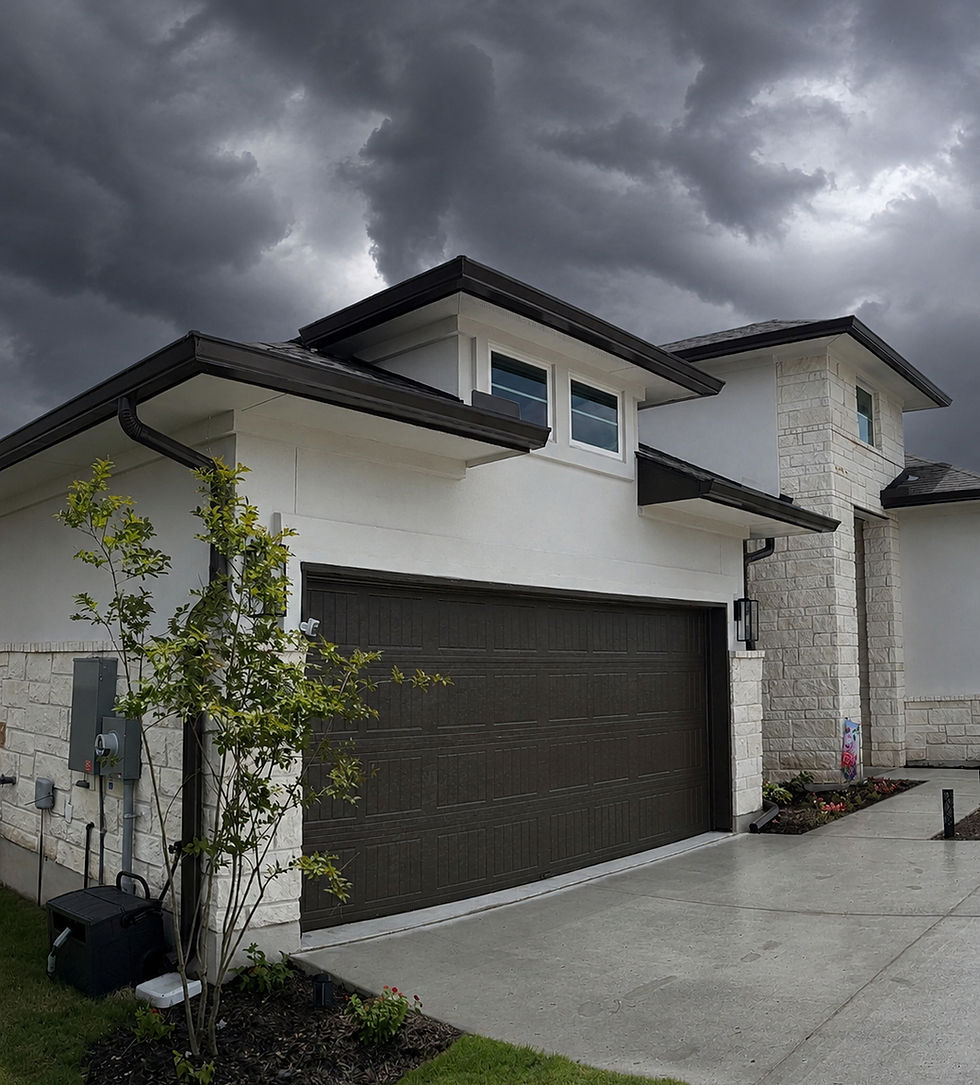
Do I Need Seamless Gutters Around My Entire House?
Updated: Sep 8
Updated September 2026, By Kyle Greer | 5 ⭐ Rated from 380+ Google Reviews

In most cases, yes. If your builder only installed gutters on the front and back of your home, the sides are still fully exposed to rain and may also be exposed to roof runoff, splashback, and wind-driven rain. A complete gutter system helps manage water around the entire home instead of protecting only certain areas.
You just bought a new home. Congratulations!
Then you walk around the property and notice something strange.
There are gutters across the front. There are gutters across the back. But the sides of the house are completely bare. So, do you really need gutters around your entire house?
Here is a better question.
Would you put sunscreen on your whole body and skip your feet?
Probably not.
The sun will still burn whatever you leave exposed. Rain works the same way. It does not politely fall only where gutters happen to be installed.
When portions of a home are left without adequate water management, rainwater and roof runoff can contribute to:
Soil erosion around the home
Water collecting near the foundation
Washed out mulch and damaged landscaping
Splashback against siding
Moisture-related deterioration of fascia and exterior materials
Muddy or bare areas beneath roof edges
That does not mean every home needs the same gutter layout. Roof design, drainage, grading, valleys, landscaping, and where water naturally travels all matter.
But it does mean that protecting only part of the home should not automatically be considered a complete drainage solution.
Why Do Some Builders Install Only Partial Seamless Gutters?
Gutter coverage on a new construction home can depend on the builder's specifications, roof design, grading and drainage plan, construction budget, or what was included in the original home package.
In some cases, homeowners receive gutters only across certain sections of the house rather than a system designed around how water moves across the entire property.
That is why we recommend looking at the home as a whole.
Where is the water coming off the roof?
Where does it land?
Where does it travel after it reaches the ground?
Is it being carried away from the home, or is it repeatedly landing beside the foundation, washing through landscaping, or splashing against exterior surfaces?
Those questions matter far more than simply asking whether a house technically "has gutters."
Why Gutters Matter in Central Texas
Water management is especially important in Central Texas because our homes can experience long dry periods followed by sudden heavy rainfall. Research from The University of Texas at Austin on expansive clay soils in Texas has documented how changes in moisture content influence the swelling and shrinking behavior of expansive soils. That does not mean a missing gutter automatically causes foundation damage.
It does mean that controlling where roof water goes is an important part of managing moisture around a home.
A properly designed gutter and downspout system collects roof runoff and directs it toward an appropriate drainage area instead of allowing large volumes of water to repeatedly discharge beside the structure.
The Department of Energy's Building America Solution Center also includes properly sized gutters and downspouts among recommended water management practices for reducing ponding and erosion around foundations. In other words, gutters are not just about keeping rain from dripping on your head when you walk out the door. They are part of a larger drainage system.
What Happens When Only Part of the Home Is Covered?
Water is patient. If rainwater repeatedly falls from an uncovered roof edge or reaches an area without adequate drainage, you may eventually begin noticing signs that water is not being managed well.
These can include:
Channels or trenches forming in the soil beneath roof edges
Mulch repeatedly washing out of flower beds
Bare or muddy areas beside the house
Water pooling after storms
Splashback or staining on siding
Moisture-related deterioration around fascia or exterior trim
Areas where large amounts of roof runoff consistently discharge close to the home
These problems usually develop gradually, which makes them easy to overlook.
One storm may not look like a big deal. But when water follows the same path during storm after storm, the effects can add up.
Does Every Single Side of a House Need Gutters?
This is where the answer gets more specific. Most homes benefit from a gutter system that manages water everywhere significant roof runoff could create a problem, but the exact layout should be based on the home's roofline and property drainage.
Not every section of every house handles water the same way. Roof pitch, valleys, gables, landscaping, hardscape, grading, downspout placement, and drainage all affect where gutters are needed and how the system should be designed.
That is why Texas Gutter Guys performs an on-site assessment instead of recommending the same gutter layout for every house. We look at how the roof sheds water and what happens to that water once it reaches the ground. The goal is not simply to install as many feet of gutter as possible. The goal is to create a gutter and drainage system that makes sense for the home.
Can I Add Gutters to the Sides My Builder Left Uncovered?
In many cases, yes. If the existing gutter system is in good condition, seamless gutters can often be added to areas that were originally left uncovered without replacing the entire system. However, it is a good opportunity to evaluate the existing gutters and downspouts at the same time. Adding gutter to another section of the home can change how much water the overall system collects. Downspout placement, discharge locations, roof valleys, and drainage should all work together. Sometimes the answer is simply adding the missing sections. Other times, adjusting a downspout or changing how water is discharged can improve the system as a whole.
How Do I Know If Missing Gutters Are Already Causing Problems?
Walk around your home after a good Central Texas rain. Look beneath the roof edges and around areas without gutters.
Watch for:
Soil erosion
Washed-out landscaping
Mulch that repeatedly moves after storms
Mud splashing onto siding
Standing water
Bare trenches beneath the roofline
Water collecting close to the foundation
Staining or moisture-related deterioration on fascia or exterior surfaces
If you notice foundation cracks, those should be evaluated separately because foundation movement can have many different causes. The gutter assessment should focus on something we can actually determine: Where is the roof water going, and is it being managed properly?
Are Seamless Gutters Worth Adding Around the Rest of the Home?
For many Central Texas homeowners, yes. Seamless gutters are fabricated specifically for the roofline, which means long gutter runs can be installed with fewer joints than traditional sectional systems. But the biggest benefit is not simply that the gutters are seamless. It is having a complete water management plan.
A properly designed system can help control roof runoff, reduce erosion, protect landscaping, limit splashback against the home, and move water toward appropriate drainage areas. If part of your home already has gutters, it is worth evaluating what happens to the water on the sections that do not. You may already be fully protected. Or you may discover that half of your drainage system is still missing.
Frequently Asked Questions
Why didn't my builder install gutters on all sides of my home?
There can be several reasons. Gutter coverage may depend on the builder's specifications, roof design, drainage plan, construction budget, or what was included with the home. A partial gutter system does not necessarily mean something was installed incorrectly, but it is worth evaluating whether water is being managed adequately around the entire property.
Is it necessary to add gutters to the uncovered sides of my house?
In many cases, yes, particularly where rain or roof runoff is causing erosion, standing water, splashback, landscaping damage, or moisture problems. The best way to determine whether additional gutters are needed is to evaluate the roofline and drainage conditions around the property.
Can I add gutters only to the missing sections?
Usually. If the existing gutters are in good condition, seamless gutters can often be added to uncovered portions of the home. The existing downspouts and drainage should also be evaluated to make sure the entire system works together.
Do gutters help protect a home's foundation?
Gutters can be an important part of foundation water management because they collect roof runoff and help direct it away from the structure. However, gutters are only one part of the equation. Grading, soil conditions, downspout discharge, drainage, irrigation, and other property conditions also affect moisture around a foundation.
How can I tell whether my home needs more gutters?
Look for erosion beneath roof edges, washed out mulch, muddy areas, standing water, splashback on siding, or large amounts of water consistently falling close to the foundation. A professional gutter assessment can also identify where the roof is shedding water and whether additional gutter coverage or drainage changes would help.
The Bottom Line
So, do you need seamless gutters around your entire house?
For most homeowners, the better question is whether water is being properly managed around the entire house. If your builder installed gutters on the front and back but left the sides uncovered, do not assume those areas are automatically protected.
And if you are not sure whether your current gutter system provides enough coverage, Texas Gutter Guys can evaluate the roofline, downspouts, landscaping, and drainage and recommend what actually makes sense for your home.
Texas Gutter Guys provides seamless gutter installation, gutter repair, gutter cleaning, advanced gutter protection, downspouts, drainage solutions, rain chains, and other gutter services throughout Central Texas.
Ready to take a look at your system? Request a free gutter assessment and let us make sure your home is covered where it matters.


Comments