


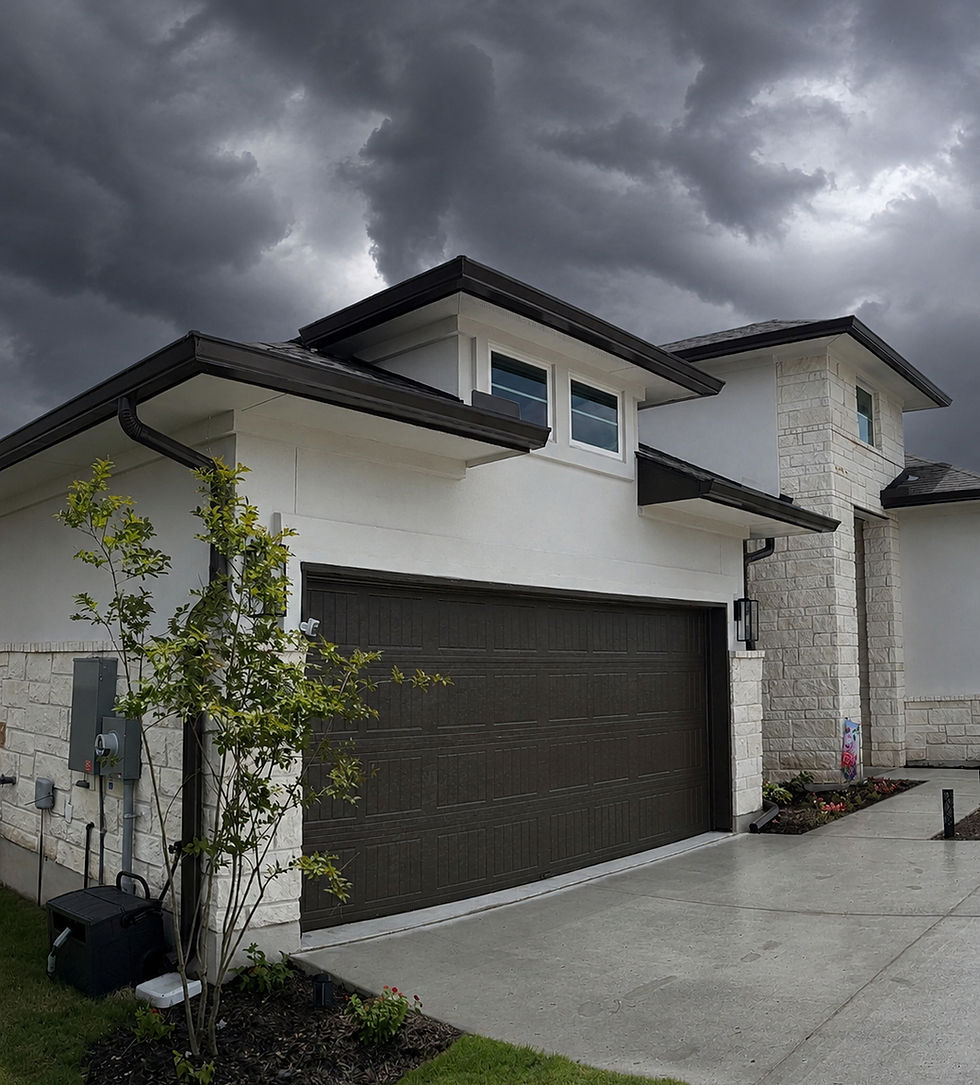
How Many Downspouts Does My House Actually Need?

There is no single correct number of downspouts for every house. The right quantity depends on the amount of roof area draining into each gutter run, how the roof concentrates runoff, gutter size, outlet and downspout capacity, run layout, roof valleys, rainfall intensity, and where the water can appropriately discharge at ground level.
Downspouts are not decorative punctuation marks added wherever the installer reaches the end of a sentence. They are the exits for the entire gutter system.
A gutter can be properly fabricated and installed and still struggle during heavy rain if the water cannot leave the system fast enough. That is why "How many downspouts does my house need?" cannot be answered by simply counting corners or dividing the roofline by a convenient number.
Kyle's take: "Gutters collect the water. Downspouts are the exit doors. If you don't have enough exits, eventually you're going to have a traffic problem."
What Determines the Number of Downspouts?
Roof Area Feeding the Gutter
Total roof area is only part of the equation. Roof pitch, intersecting rooflines, valleys, and upper roof sections can concentrate a significant amount of runoff into a relatively small section of gutter. Two homes with similar square footage can therefore require very different gutter and downspout layouts. A roof valley dumping a large volume of water into one short section deserves more attention than a roof plane that distributes runoff evenly across a long gutter run.
How the Roof Delivers That Water
Total roof area is only part of the equation. Roof pitch, intersecting rooflines, valleys, and upper roof sections can concentrate a significant amount of runoff into a relatively small section of gutter. Two homes with similar square footage can therefore require very different gutter and downspout layouts. A roof valley dumping a large volume of water into one short section deserves more attention than a roof plane that distributes runoff evenly across a long gutter run.
Gutter Size
Larger gutters can carry more water, but that water still needs an adequate way to exit the system. The outlet and downspout capacity should work with the gutter rather than becoming a bottleneck. Industry design guidance recommends selecting enough downspout capacity to adequately handle the water the gutter is designed to carry.
Texas Gutter Guys follows North American gutter installation standards and industry best practices when evaluating gutter and downspout systems. Texas does not have a statewide gutter installation code.
Length and Layout of the Gutter Run
A long gutter run may receive runoff from a substantial roof area, especially when valleys or multiple roof sections feed the same section. If one outlet cannot adequately handle that volume, an additional downspout can divide the drainage load and give water another exit point. The goal is not simply to install a downspout every certain number of feet. The entire run needs to be evaluated based on how much water it receives and where that water can go.
Roof Valleys and Upper Roof Discharge
Valleys can concentrate water very quickly. Upper roof sections can also discharge onto lower roofs, increasing the amount of runoff that eventually reaches the gutter below.
A section receiving concentrated runoff may benefit from an outlet or downspout nearby even when the overall gutter run is not particularly long.
Rainfall Intensity
Central Texas does not always believe in easing into a storm. A gutter system needs to manage short periods of intense rainfall, not just an average rainy day. Rainfall intensity is one of the established variables considered when roof drainage systems are sized.
That is especially important in Central Texas, where a short, heavy storm can send a substantial amount of roof runoff into the gutter system very quickly.
Available Discharge Locations
A downspout needs somewhere appropriate to release the water it collects.
Adding more downspouts is not automatically helpful if those downspouts terminate directly beside the foundation, across a walkway, against landscaping that will wash out, near air-conditioning equipment, or in a location that creates a new drainage problem.
Quantity matters, but placement matters just as much.
Why One Downspout May Not Be Enough
One outlet at the end of a heavily loaded gutter run can become a bottleneck.
If a large amount of roof area, valleys, or multiple roof sections are feeding the gutter, one downspout may be asked to handle more water than the outlet configuration can efficiently discharge. This is the gutter equivalent of opening one checkout lane the Saturday before Thanksgiving and then acting surprised by the line.
Adding another strategically placed downspout can sometimes divide that workload and improve how quickly the gutter drains. However, another downspout is not automatically the answer. The gutter size, outlet size, pitch, roof geometry, and discharge location all need to be considered first.
Can You Have Too Many Downspouts?
Technically, additional outlets can improve drainage capacity, but more is not automatically better.
Every downspout affects:
Appearance
Landscaping
Patios and walkways
Driveways
Gates and access points
Foundation drainage
Ground-level runoff
Where water ultimately travels after leaving the roof
An unnecessary or poorly placed downspout can simply move a water problem from the roofline to the ground. The goal is not to install the most downspouts possible. It is to install the appropriate number in the appropriate locations.
Does Downspout Size Matter?
Yes. In this case, size does matter. The outlet and downspout need enough capacity to handle the amount of water being delivered by the gutter. Increasing outlet or downspout capacity can sometimes improve drainage when the existing outlet is the bottleneck, but sizing should be evaluated as part of the entire gutter system rather than treated as a standalone fix.
A larger downspout will not compensate for every other problem in the system.
Signs Your Home May Need Another Downspout
Your gutter system may benefit from an additional or relocated downspout if:
Overflow repeatedly occurs near the middle or far end of a long gutter run
One downspout receives runoff from several roof sections or valleys
The gutter remains heavily loaded even while the downspout is flowing
Water repeatedly remains in a long section of gutter because the existing outlet configuration is not allowing the system to drain effectively
Repeated cleaning or minor repairs have not corrected the overflow
A home addition, patio cover, roof modification, or other improvement changed the drainage pattern
A large roof valley consistently overwhelms one section of gutter during heavy rain
The current downspout location creates poor ground-level drainage and another location would better serve the system
Overflow does not automatically mean another downspout is required. It may also indicate an obstruction, incorrect pitch, an undersized gutter, concentrated valley runoff, water overshooting the gutter, or another issue that should be evaluated. For a deeper look at overflow that happens without a clog, see Why Are My Gutters Overflowing During Heavy Rain if They Are Not Clogged?
Can a Downspout Be Added to Existing Gutters?
Often, yes. If the existing gutter system is otherwise in good condition, another outlet and downspout may be added to help divide the drainage load.
Before adding one, a professional should evaluate:
Existing gutter condition
Gutter size
Outlet size
Gutter pitch
Roof area feeding the run
Roof valleys and concentrated runoff
Fascia condition
Available downspout routing
Ground-level discharge location
Adding a downspout is most useful when the rest of the system is sound and the new downspout has an appropriate place to discharge.
Why Downspout Placement Is a Whole-Property Decision
The best location hydraulically is not always the best location for the rest of the property.
Patios, driveways, gates, landscaping, air-conditioning equipment, neighboring properties, and the home's foundation all need to be considered. Texas Gutter Guys evaluates where each downspout can reasonably terminate as part of the gutter system.
We provide above-ground gutter drainage solutions, including appropriately placed downspouts and extensions when needed. Underground drainage systems, grading, and broader site-drainage work are outside the scope of our gutter installations. The goal is to create a visible, serviceable path for roof runoff without simply transferring the problem somewhere else.
Frequently Asked Questions
How Many Downspouts Does the Average House Need?
There is not a reliable house-wide average that can determine what your specific home needs.
A simple roof may perform well with fewer strategically placed downspouts, while a home with long gutter runs, several valleys, upper roof sections, or concentrated runoff may require more.
Downspouts should be sized and placed according to the amount of roof runoff each section of gutter receives and where that water can appropriately discharge.
How Far Apart Should Downspouts Be?
Rules of thumb exist, but spacing alone is not enough to determine proper downspout placement. Roof area, gutter size, outlet capacity, roof valleys, rainfall intensity, gutter layout, and discharge location all matter. Two gutter runs of the same length may require different downspout layouts because they receive very different amounts of roof runoff.
Do I Need a Downspout Every 30 or 40 Feet?
You may see general recommendations suggesting a downspout every 30 to 40 feet, but that should not be treated as a universal rule. A 35-foot gutter receiving runoff from a large roof valley may have very different drainage requirements than a 35-foot gutter serving a small porch. Texas Gutter Guys evaluates the individual roof and gutter run rather than installing downspouts according to one blanket spacing rule.
Can One Downspout Serve Two Gutter Runs?
Sometimes. Whether one downspout can adequately serve two connected gutter runs depends on how much roof area feeds them, how the runs connect, and whether the outlet and downspout have enough capacity to handle the combined flow.
Why Does My Gutter Overflow Far Away From the Downspout?
Overflow away from the downspout can occur when a long or heavily loaded gutter run cannot move water toward the available outlet quickly enough. Other possible causes include concentrated valley runoff, an obstruction, improper pitch, an undersized gutter or outlet, or water overshooting the gutter. The location of the overflow can provide useful information, but the entire system should be evaluated before assuming another downspout is the solution.
Why Is My Downspout Loud During Rain?
Fast-moving water, elbows, metal surfaces, loose components, or a high volume of runoff entering one downspout can all create noise. A noisy downspout is not automatically a problem. However, the system should be evaluated if the noise occurs alongside overflowing gutters, movement, leaking joints, or other drainage issues.
Can a Larger Downspout Fix an Overflowing Gutter?
Sometimes, but only when outlet or downspout capacity is actually the bottleneck.
A larger downspout will not correct poor gutter pitch, an undersized gutter, concentrated water overshooting the gutter, a hidden obstruction, or another issue elsewhere in the system. The gutter, outlet, and downspout should function as one drainage system.
Where Should Downspouts Discharge?
Downspouts should direct roof runoff to an appropriate above-ground discharge location where the water can continue moving away from vulnerable areas of the home.
The goal is to avoid concentrating water immediately beside the foundation or creating new issues such as erosion, standing water, washout, slippery walkways, damage to landscaping, or runoff onto neighboring property.
Because many Central Texas homes are built on slab foundations, where roof runoff is discharged deserves just as much attention as how the water leaves the gutter.
Conclusion
The right number of downspouts is not determined by the number of corners on your house or a universal spacing formula.
A properly planned gutter system considers the complete path of the water:
Roof → Gutter → Outlet → Downspout → Above-Ground Discharge
If any part of that path becomes a bottleneck, the system may overflow or move water somewhere you do not want it.
That is why Texas Gutter Guys evaluates the roofline, gutter runs, valleys, gutter size, outlet capacity, downspout placement, and ground-level discharge together rather than treating each component separately.


Comments