


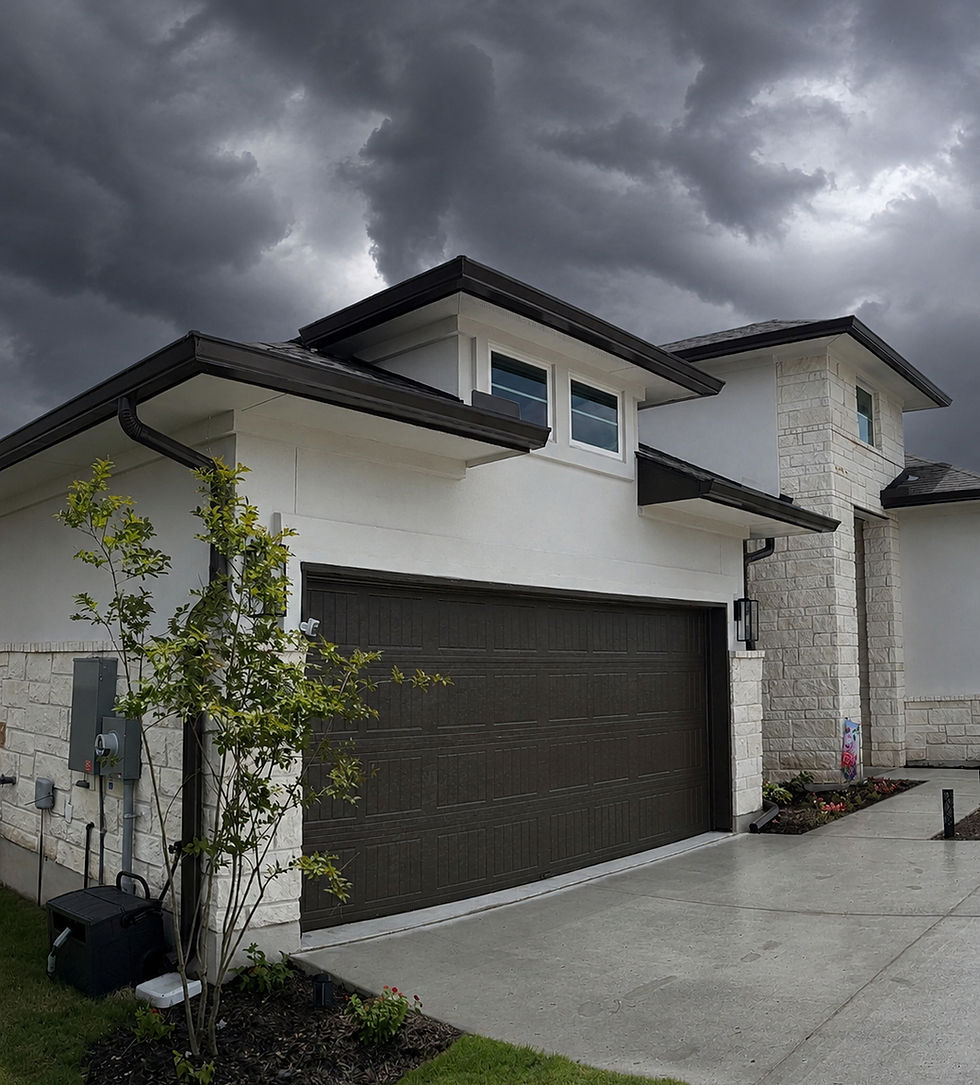
New Construction Home Without Gutters in Texas: Is That Normal?
Updated August 2026, By Kyle Greer | 5 ⭐ Rated from 371+ Google Reviews

You signed a heroic stack of closing documents, received the keys, and discovered your brand new house has smart switches, six cupholders in the kitchen island, and absolutely no plan for the thousands of gallons of water that can leave the roof during a storm.
Welcome to new construction.
The simple answer: Yes, it's common for new Texas homes to arrive without gutters. But common does not mean your roof runoff should just become someone else's problem.
In Central Texas, every home (new or old) needs an intentional plan for collecting roof water and directing it safely away from the foundation, landscaping, entrances, siding, and AC equipment. This guide walks you through why builders sometimes leave gutters off, whether your new home actually needs them, and what to assess before installation.
Are Gutters Required on New Construction Homes in Texas?
The answer depends on building code jurisdiction and your specific property. Some municipalities require gutters. Others leave it to owner preference. Texas does not impose a statewide gutter requirement.
But here's what matters more than code: your roof still produces runoff from day one, regardless of whether it was on the builder's selection sheet.
FEMA recommends maintaining gutters and downspouts so roof water flows away from the building. The U.S. Environmental Protection Agency identifies properly managed roof drainage as critical to protecting foundation integrity and preventing moisture problems.
Translation: Whether gutters are legally required in your jurisdiction or not (they are not required in the state of Texas), your new home needs a strategy for managing thousands of gallons of water falling from the roof during a Central Texas thunderstorm.
Why Did My New Construction Home Come Without Gutters?
Builders leave gutters off new construction for several reasons. None of which are "gutters add zero value to the home."
Common Builder Reasoning
Gutters are treated as an upgrade. Some builders include a base package and offer gutters as an optional add on (sometimes at premium pricing). This shifts the decision and cost to the buyer.
Partial gutters only. Builders may install short sections above the front door or covered patio (to protect guests and their cars) but skip the rest, assuming grading and landscaping handle the rest. Many new construction homes in Central Texas come with gutters on the front and back but nowhere on the sides.
Scope limitation. The builder's contract may define their work boundary as ending at the roof edge. Landscaping, drainage, and exterior finishes become the owner's responsibility after closing.
Regional standard. In some Texas markets, homes routinely come without gutters. If that's normal in your subdivision, the builder may follow that pattern without reconsidering whether it's appropriate.
Fascia challenges. Some modern home designs have minimal or complex fascia, making gutter installation awkward or expensive. Builders may decide the visual trade off isn't worth it in their design.
Kyle's Take: "A new house can still have an old fashioned water problem. New paint and fresh sod don't make roof runoff disappear. We see brand new homes in Austin, Cedar Park, Liberty Hill, Leander, and all around Central Texas with the same foundation and landscape water damage patterns as homes from the 1980s, all because someone assumed the yard could handle what the roof produces."
Is There Data on How Many Central Texas Homes Skip Gutters?
Here's the honest answer: there's no official count. No building association or city tracks what percentage of new Central Texas homes get built with gutters versus without. If you see a specific percentage floating around online, treat it with a healthy amount of skepticism, it's likely a guess dressed up as a fact.
What we can tell you, from evaluating rooflines across Central Texas every week, is what actually determines whether a builder includes gutters:
Soil and foundation type. Homes sitting on expansive clay are far more likely to need a full gutter system than homes on more stable ground, though builders don't always factor this in at the time of construction.
Cost. Every linear foot of gutter is a line item. Builders working within a tight budget per square foot often trim it, especially on elevations buyers don't walk past on a listing tour.
Roof design and overhang. Homes with steep pitches and generous overhangs can shed water further from the foundation on their own, which sometimes (not always) reduces the perceived need for gutters.
Grading and lot layout. If the builder's grading plan assumes water will sheet away from the slab naturally, gutters can get treated as optional rather than essential, even in neighborhoods where lots sit close together with almost nowhere for that water to go.
The bottom line: whether your home got gutters wasn't decided by a Central Texas weather forecast. It was decided by a builder's budget, floor plan, and grading assumptions on the day your house went up. That's exactly why a professional assessment after closing matters. It looks at your specific roof and lot, not the builder's average.
Does Every Central Texas Home Need Gutters?
Texas Gutter Guys' position is direct: Yes. Every Central Texas home needs an intentional roof water management system, and for typical residential construction that means properly sized gutters and downspouts.
The design may vary by roofline, foundation type, lot slope, landscaping, and architecture. But uncontrolled runoff is not a strategy.
Why Central Texas Homes Are Different
Intense rainfall events. Central Texas doesn't receive consistent, gentle rain. Instead, it gets flash flood level downpours (2 to 3 inches in under an hour during summer thunderstorms). Roof runoff volumes are massive and concentrated.
Expansive clay soil. When water pools at the foundation of a Central Texas home, the clay soil expands, pushing against the foundation walls. Dry periods shrink the soil, creating settling. This cycle causes foundation cracks, door and window binding, and structural issues costing $15,000 to $40,000+ to repair.
No basement drainage advantage. Many new construction homes in Central Texas are slab on grade (no basement). Slab homes have zero subsurface water management. All foundation protection depends on surface drainage and gutters.
Roof area and pitch. Newer construction often includes larger roof areas and steeper pitches than older homes, meaning more water volume hitting the ground in a smaller area.
Landscaping concentration. New construction subdivisions often place homes close together with small yards. There's nowhere for runoff to disperse naturally. It either gets managed by gutters or it pools against the house.
InterNACHI (the International Association of Certified Home Inspectors) identifies gutters and downspouts as the most common residential roof drainage system and warns that runoff discharged beside a foundation can contribute to serious moisture and soil problems.
Signs Your New Central Texas Home Needs Gutters Now, Not Someday
Don't wait for the first storm to discover whether your new home needs gutters.
Look for these warning signs during normal rainfall or landscape irrigation:
Trenches forming beneath roof edges after rain (water is concentrating and eroding soil)
Mulch or decorative rock repeatedly washing out (landscaping can't handle roof volume)
Water splashing onto windows, doors, siding, or brick during rain (soaking exterior materials)
Puddles near the slab or at low corners of the home (foundation saturation starting)
Water falling across walkways, patios, or entry doors (creating slip hazards and water damage)
Roof valleys dumping concentrated water into one flower bed (destroying landscaping faster than grading can compensate)
Soil erosion near the AC unit or utility areas (water pooling under equipment, reducing lifespan)
Fresh landscaping can hide drainage patterns for a while. Then the first proper Central Texas storm arrives and the yard submits its warranty claim to you, the owner.
New Construction Home Gutters and Home Inspection
A professional home inspector evaluates visible roof drainage components and notes missing, incomplete, damaged, or poorly discharging systems in the inspection report.
However, an inspection report is not the same as a custom gutter design.
A gutter professional evaluates:
Roof area, pitch, valleys, and upper roof discharge patterns
Fascia condition, attachment surface, and roof edge details
Drip edge position and waterproofing integration
Appropriate gutter size for the roof and Central Texas rainfall conditions
Number and placement of downspouts for balanced water distribution
Above ground discharge paths that don't create new pooling or erosion
Color selection that coordinates with trim, roof, masonry, and architecture
New does not automatically mean correct. Texas Gutter Guys regularly finds new homes with uneven fascia, questionable roof edge details, awkward downspout locations, or landscaping that leaves very few sensible discharge points. The system should be designed for your actual home, not copied from the house three doors down.
Why Partial Gutters Are Often Not Enough
A small section above the front door may stop guests from receiving an accidental shower. It does not protect the rest of the foundation or landscaping. Partial systems can be appropriate for certain architectural details, but they should be part of a whole home runoff plan, not random decorative eyebrows.
The Sunscreen Problem: Gutters on Front and Back Only
Many new construction homes in Central Texas come with gutters installed on the front and back rooflines but not on the sides. This creates a critical vulnerability, and it's worth understanding why builders make this choice in the first place.
Why builders skip the sides
Visibility. Front and back elevations are what buyers see in listing photos and walk the lot to admire. Side elevations usually face a fence line or the neighbor's yard, so they're easy to deprioritize.
Guest protection, not water management. That front door or patio section exists to keep visitors dry for the ten seconds it takes to reach the door. It was never designed to manage the total water load coming off the roof.
Cost per linear foot. Every foot of gutter adds to the invoice. Side elevations are often the longest runs on a rectangular floor plan, so skipping them is one of the cheapest ways to trim the budget without the house looking obviously gutter-less from the street or backyard.
Assuming grading will handle it. Builders often bet that a few feet of side yard and standard grading will move water to the property line before it becomes a problem. In Central Texas clay, during a real downpour, that assumption falls apart fast.
Why it matters
Think of it this way: going outside in Central Texas heat and applying sunscreen to everything but your feet. Your feet are still getting burned. Leaving gutters off the side rooflines means water is pouring down your home's sides with nothing to stop it.
The side walls of your home get just as much rainfall as the front and back. Water runs off the side rooflines with the same force and volume. Without gutters, that water cascades directly onto the foundation perimeter, landscape, and siding on both sides of the house.
Partial gutters often create worse problems than no gutters at all. You get a false sense of protection (some gutters are installed, after all), but the gaps are exactly where the most damage occurs. Water concentrates at the edges of the gutter coverage and erodes soil, damages landscaping, and saturates the foundation at those specific points.
Consider this: A typical 2,000 to 2,500 square foot home's roof collects thousands of gallons during a Central Texas thunderstorm. If only 50% of the roofline has gutters (front and back but not sides), then 50% of that water is hitting the ground uncontrolled. That's thousands of gallons of unmanaged runoff assaulting your foundation perimeter every time it storms during a typical Central Texas summer.
What to Check Before Installing Gutters on Your New Home
Before you call a gutter installer, or before you negotiate with your builder, understand what condition your home is actually in:
Structural Assessment
Fascia condition and attachment surface (is it solid enough for gutter hangers?)
Drip edge position and roof edge details (some new construction has unconventional edges)
Roof pitch, valleys, and upper roof discharge (where does water naturally concentrate?)
Sizing and Capacity
Appropriate gutter size for your roof and Central Texas rainfall conditions (4-inch gutters are undersized; 5 to 6 inch is standard)
Number and placement of downspouts (gutters need adequate outlets)
Downspout sizing (downspout capacity must match gutter capacity)
Discharge Planning
Above ground discharge paths that don't create new pooling or erosion
Foundation clearance (downspouts should discharge 6 to 10 feet from the foundation)
Grading and slope around the home (does water naturally flow away?)
Landscaping location (will gutters discharge across new plantings?)
Aesthetics and Integration
Color selection that works with the trim, roof, masonry, and architecture
Gutter guard needs (do nearby trees require debris protection?)
Architectural details (dormers, bay windows, and complex rooflines require custom planning)
A professional gutter assessment handles all of this for you before you make installation decisions.
Does a New Home Automatically Need Gutter Protection?
No. Every Central Texas home needs gutters, but not every home requires gutter protection.
Gutter protection (guards, covers, or screens) depends on:
Nearby trees (heavy oak or cedar coverage means protection is likely needed)
Roof design (valleys and complex geometry mean more debris accumulation)
Debris type (oak leaves, pollen, and roof granules call for different protection strategies)
Maintenance expectations (some owners prefer no maintenance systems)
Service accessibility (can gutters be safely cleaned if needed?)
A brand new house in an open field with minimal tree coverage may not need protection initially. One tucked beneath mature oaks, cedar, or pine trees almost certainly will.
Central Texas has year round debris problems (oak leaf drop, cedar pollen, roof granule shedding), so most homeowners eventually add protection. Planning for it during initial installation is cheaper than retrofitting later.
Frequently Asked Questions
Can gutters be installed after landscaping is complete? A: Yes, though planning is important. Downspout placement should be carefully considered so runoff doesn't damage newly installed plants or create water problems beside the foundation. A professional assessment can identify the best discharge locations before landscaping is finalized.
Should new gutters match the roof or trim? A: Either approach can work architecturally. Many homeowners match fascia or trim so gutters blend into the home's lines. Others use a contrasting architectural color for visual interest. Samples should be viewed outside against the actual home in natural light.
Is there a best time to install gutters on a new home? A: Before the first heavy rain is ideal. If landscaping is ongoing, gutters can be installed once fascia and roof work are complete but before final grading and planting are finished.
Can I install gutters myself on my new construction home? A: Gutter installation requires proper measurements, roof access, hanger spacing, and slope calculations. Improperly installed gutters may fail during the first storm or cause fascia and foundation damage. Professional installation is recommended.
How much does gutter installation cost for a new home? A: Pricing varies by home size, roofline complexity, gutter size, and whether gutter protection is included. A professional assessment provides accurate pricing for your specific situation. Texas Gutter Guys provides free on-site assessments throughout Greater Austin and Central Texas.
The Bottom Line
It may be common for a new Texas home to arrive without gutters, but your roof still produces runoff from day one.
The right system protects more than the slab. It helps protect landscaping, siding, fascia, entrances, patios, and the walkways where your family actually lives.
If your new construction home came without gutters (or with only partial gutters), an on-site assessment will show you exactly what your specific roof needs, whether your foundation and landscaping are already at risk, and what options work best for your site.
Did your builder give your roof plenty of shingles but no instructions for where the rain should go?
Texas Gutter Guys provides free on-site assessments throughout Greater Austin and Central Texas, including Cedar Park, Liberty Hill, Leander, Georgetown, Round Rock, Hutto, Kyle, Dripping Springs, Pflugerville, and surrounding communities.
We evaluate the roofline, fascia, drip edge, downspout options, and above ground discharge path, then explain what your home actually needs without treating every house like the same cookie cutter floor plan.
Request a free on-site gutter assessment. Call 512-316-9077 or visit our website to schedule.


Comments